Costa del Sol
Gaucín
A local guide to Gaucín on the Costa del Sol: what the area is like, who lives here, and live asking prices.
Overview
About Gaucín
Climate, transport, population and what Gaucín is known for.
Gaucín sits at 626 metres above sea level in the Serranía de Ronda, a white village perched on a ridge with views across to Gibraltar and the Rif Mountains of Morocco. For property buyers, it offers mountain authenticity at €2,590 per square metre as of June 2026, roughly half the Costa del Sol average of €5,575 per square metre. The twelve active listings in June 2026 ranged from €85,000 to €3,300,000, reflecting a market split between modest village houses and substantial rural estates.
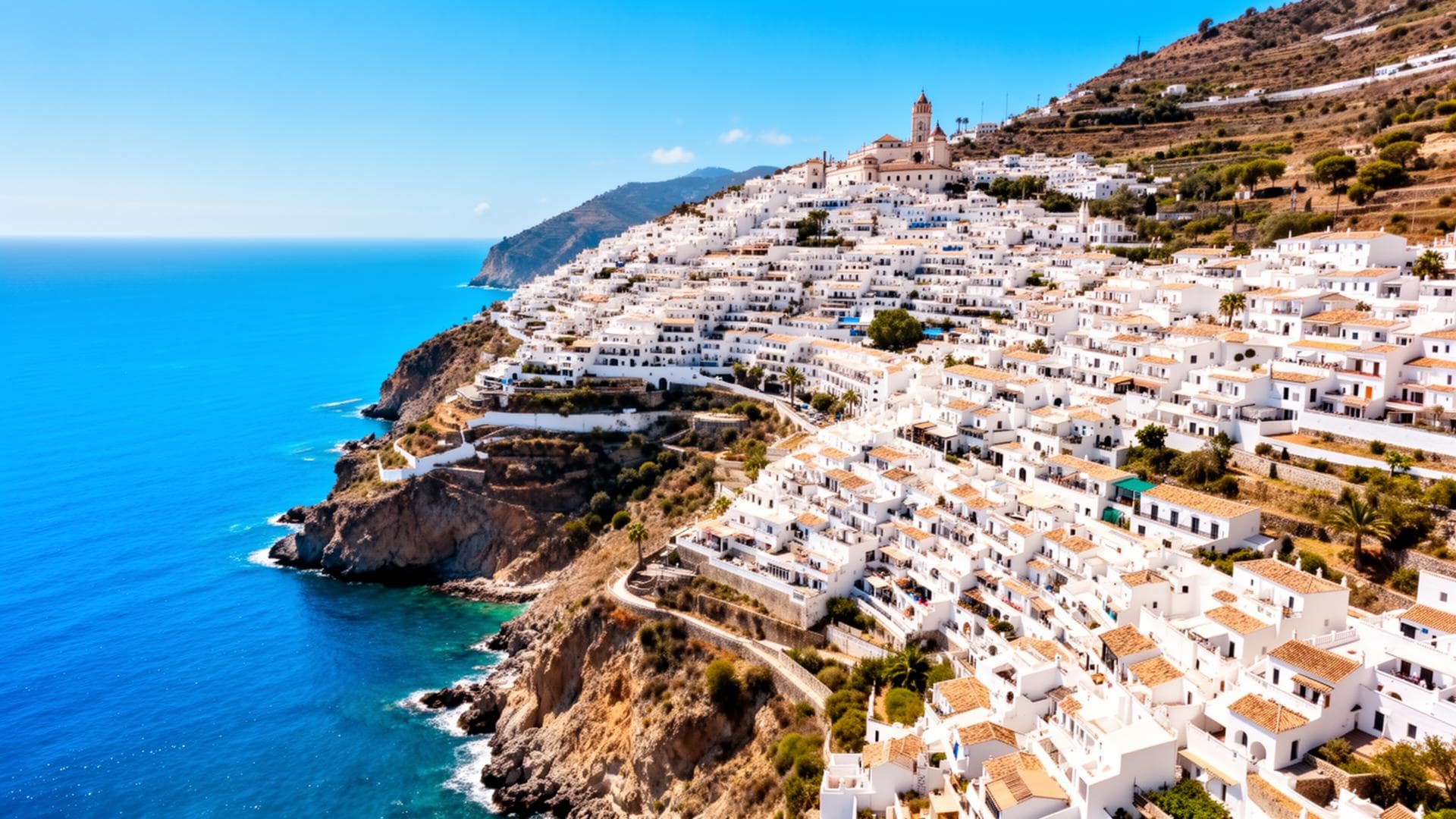
The village climbs steeply from the lower plaza at Calle Convento up to the ruined Castillo del Águila, which crowns the ridge and provides the visual anchor for the entire settlement. Most of the residential streets are too narrow for cars, so daily life involves walking steep cobbled lanes past whitewashed houses with terracotta roofs and wrought iron window grilles. The Calle San Juan and Calle Luis Armiñán wind through the oldest part of the village, where doorways open directly onto the street and neighbours still sit outside on summer evenings. The main social hub is the Plaza de España, where Bar La Fragua and Café Bar Paco serve as informal meeting points for both Spanish residents and the sizable contingent of British and Dutch expats who have settled here since the 1980s. Unlike the coastal resorts an hour to the south, Gaucín has no tourist infrastructure beyond a handful of guesthouses and restaurants. The population of around 1,500 swells slightly in summer but never transforms the village into a seasonal economy. Most shops close between two and five in the afternoon, and the village falls silent after ten at night except on fiesta weekends. The foreign residents here tend to be artists, writers, or retirees seeking rural immersion rather than golf club membership. The local economy still revolves around agriculture, particularly chestnut and cork oak harvesting, and you will see working farmland within five minutes' walk of the village centre. This is not a place that has been preserved for outsiders. It functions as a living Spanish pueblo that happens to accommodate a minority of non-Spanish residents who have adapted to its rhythms rather than the other way around.
The average price per square metre in Gaucín stood at €2,590 as of June 2026, placing it well below comparable inland municipalities such as Archidona at €7,059 per square metre and far below coastal Marbella at €6,908 per square metre. The twelve active listings in June 2026 had an average asking price of €1,239,700, but this figure is skewed by two high-value rural estates. The price range stretched from €85,000 for a small village house requiring renovation to €3,300,000 for a large finca with land. The single apartment listing was priced at an average of €1,967 per square metre, while the two villas averaged €4,416 per square metre, reflecting the premium attached to properties with land and unobstructed views. Three townhouses were also on the market, typically priced between €150,000 and €350,000 depending on condition and size. The market here moves slowly compared to the coast. Properties can sit for six months or longer, and sellers willing to negotiate on price tend to achieve sales more reliably than those holding firm. Buyers are predominantly northern Europeans seeking a second home or permanent relocation, with a smaller number of Spanish buyers from Málaga or Sevilla looking for weekend retreats. The limited inventory reflects the fact that much of the housing stock remains in Spanish family ownership, passed down through generations rather than traded on the open market. There is no new construction within the village core due to planning restrictions aimed at preserving the historic character, so supply is constrained to existing homes and rural plots outside the village boundaries. Financing can be more complex for older village houses that lack modern building certificates, and some properties have unclear title histories that require legal due diligence. Cash buyers have a distinct advantage in this market, both in negotiating power and in avoiding the delays that mortgage approvals can introduce when dealing with non-standard properties.
Daily life in Gaucín revolves around the village itself rather than external amenities. Mornings begin with coffee at one of the bars on Plaza de España, where regulars collect bread from Panadería Gómez and catch up on village news. The weekly market on Sundays brings vendors selling local produce, cheese, and olives, though most residents drive to the larger market in Ronda on Saturdays for a fuller selection. Walking is the primary leisure activity, with trails leading out from the village into the surrounding sierra, including the path up to the Castillo del Águila and longer routes towards the Genal Valley. The village has no golf courses, no marina, and no beach within an hour's drive. The nearest coast is Sotogrande, forty-five minutes by car via winding mountain roads. What Gaucín offers instead is a slower, more self-contained rhythm. Evenings are spent at home or at one of the village restaurants such as La Fructuosa or El Hondillo, both of which serve traditional Andalusian dishes rather than international cuisine. The social calendar revolves around local fiestas, particularly the Semana Santa processions in spring and the Feria de Gaucín in August, when the village comes alive with music, dancing, and temporary bars set up in the streets. The expat community organizes informal gatherings, art exhibitions at the Casa de Cultura, and walking groups, but integration with Spanish village life is expected and generally achieved over time. Winters are quiet, cool, and occasionally rainy, with mist rolling in from the mountains and wood fires burning in most homes. This is not a place for those seeking constant stimulation or a wide range of dining and entertainment options. It suits buyers who find satisfaction in landscape, simplicity, and the routines of a small community.
Gaucín attracts buyers who prioritize authenticity and affordability over convenience and amenities. Retirees from northern Europe form the largest group, typically people who have spent years visiting Spain and are ready to commit to village life. Artists and remote workers are also drawn here, valuing the low cost of living and the quiet that allows for focused work. Families with school-age children are rare because the nearest international schools are in Sotogrande or Marbella, both requiring a daily commute of at least forty-five minutes each way. Buyers seeking a lock-up-and-leave holiday home may find the village too remote and the property maintenance too demanding, particularly for older houses that require regular attention. Those who need reliable high-speed internet should verify connectivity before purchasing, as speeds vary significantly depending on the exact location within the village. What keeps people here is the combination of affordability, the quality of light and landscape, and the sense of living in a place that has not been designed for outsiders. It is a choice that requires compromise but delivers a depth of experience that the coastal resorts cannot match.
Gaucín is ninety minutes by car from Málaga-Costa del Sol Airport via the A-7 and A-369, a route that includes thirty kilometres of winding mountain road with limited overtaking opportunities. Gibraltar Airport is closer at fifty-five minutes, but flight options are limited compared to Málaga. The nearest hospital with emergency services is in Ronda, thirty-five minutes away, while the closest international schools are in Sotogrande, forty-five minutes to the southwest. The village has a health centre staffed by a doctor and nurse, and a pharmacy on Calle Convento. Mobile phone coverage is generally reliable, though some properties on the outskirts experience weaker signals. The nearest supermarket with a full range of products is a Mercadona in San Roque, forty minutes away, though the village has two small grocery shops for daily essentials. Reliable tradespeople are available locally, but specialist services such as pool maintenance or advanced carpentry often require calling contractors from Ronda or the coast, which adds to both cost and scheduling complexity.
The physical layout of Gaucín shapes daily experience in ways that are not immediately obvious to first-time visitors. The village is divided into several distinct barrios, each with its own character. The Barrio Alto, clustered around the castle ruins, offers the most dramatic views but also the steepest access and the oldest, most tightly packed housing stock. Properties here are often small, with two or three rooms spread over multiple levels connected by narrow staircases. The Barrio de San Juan, slightly lower down, has marginally wider streets and a mix of traditional village houses and a few larger properties built in the early twentieth century. The lower part of the village, around Calle Convento and the main road that passes through, has easier vehicle access and includes some newer construction from the 1970s and 1980s, though even these properties are built in the traditional white-village style. Outside the village core, scattered fincas and cortijos sit on plots ranging from one to fifty hectares, offering privacy and land but requiring self-sufficiency in terms of water supply, septic systems, and road maintenance. Many of these rural properties rely on well water or shared irrigation channels, and buyers need to verify water rights as part of the purchase process. Electricity is connected to most properties, but some remote fincas still depend on generators or solar panels. The appeal of these rural estates is obvious, views uninterrupted by neighbours, space for horses or organic farming, and a level of tranquility that even the village centre cannot provide. The trade-off is isolation, particularly in winter when rain can make unpaved access tracks impassable for days at a time.
The social fabric of Gaucín is more complex than the postcard image of a sleepy white village suggests. The Spanish population is aging, with many younger people having moved to Málaga, Sevilla, or abroad for work. This has created opportunities for foreign buyers to acquire properties that might otherwise have remained within families, but it has also meant that the village has had to adapt to an influx of outsiders who do not always speak Spanish fluently or understand local customs. Relations between Spanish residents and expats are generally cordial but not always deeply integrated. The expat community tends to socialize among itself, organizing book clubs, art classes, and charity events that operate in parallel to the traditional Spanish social structures centered on family, church, and the local bars. Some long-term foreign residents have made genuine efforts to learn Spanish, participate in village fiestas, and support local businesses, and these individuals are generally well-regarded. Others remain more isolated, conducting their lives in English and interacting primarily with other expats. The village has a small but active cultural scene, with occasional concerts, theater performances, and art exhibitions held at the Casa de Cultura on Calle Luis Armiñán. The library, also located in the Casa de Cultura, has a modest collection of books in Spanish and a smaller selection in English. For buyers considering Gaucín, it is worth spending time in the village before committing to a purchase, attending local events, and speaking with both Spanish and expat residents to get a realistic sense of whether the community dynamics will suit your temperament and expectations.
On clear days, the view from the Castillo del Águila extends across the Strait of Gibraltar to the mountains of North Africa, a sight that has drawn travelers and settlers to this ridge for centuries. The castle itself is a ruin, its walls crumbling and its interior overgrown with wild grasses, but it remains the symbolic heart of the village. Local children play in its shadow, and on summer evenings, residents and visitors alike climb the steep path to watch the sun set over the sierra. This is the image that stays with buyers who choose Gaucín, not the promise of luxury or convenience, but the enduring presence of a place that has resisted the pressures of mass tourism and remains, for better or worse, stubbornly itself.
What you'll find here
What's nearby
Getting around Gaucín
Gaucín properties
Featured properties in Gaucín
Hand-picked homes in Gaucín, Costa del Sol.

8-bed Finca in Gaucín
Gaucín · Costa del Sol
€3.30M
Price
8
Beds
7
Baths
600 m²
Built area

8-bed Villa in Gaucín
Gaucín · Costa del Sol
€3.30M
Price
8
Beds
8
Baths
600 m²
Built area

9-bed Finca in Gaucín
Gaucín · Costa del Sol
€2.49M
Price
9
Beds
7
Baths
838 m²
Built area

9-bed Finca in Gaucín
Gaucín · Costa del Sol
€1.55M
Price
9
Beds
6
Baths
525 m²
Built area
Gaucín properties
Gaucín, every budget, every intent
Gaucín properties updated daily from live listings.
Price reduced
Motivated sellers, prices reduced this month
New to market
Just listed, fresh to market this week
Property types
Property types in Gaucín
19 homes across 4 property types in Gaucín.
Apartments
Gaucín
Apartments for sale in Gaucín
1
Listings
€1,988
Avg / sqm
Villas
Gaucín
Villas for sale in Gaucín
4
Listings
€1,988
Avg / sqm
Townhouses
Gaucín
Townhouses for sale in Gaucín
7
Listings
€1,988
Avg / sqm
Fincas
Gaucín
Fincas for sale in Gaucín
7
Listings
€1,988
Avg / sqm
Search by setting
Beachfront, sea view & south facing in Gaucín
Sea view
Spectacular sea view homes
Gated community
Secure gated community homes
Gaucín guides
Guides for buying and living in Gaucín
In-depth guides for international buyers considering Gaucín, Costa del Sol.
How to buy property in Spain: the 2026 guide
Taxes, legal steps, timelines, viewing trips, financing, and the quirks foreign buyers need to know, step by step.
The costs of owning property in Spain
IBI, the Modelo 210 tax non-residents forget, community fees and selling costs, with 2026 Andalucía rates and a worked example.
Is buying property in Spain a good idea in 2026?
An honest verdict with town-by-town Costa del Sol prices, the real risks, and who should not buy.